















 | What We Do How We Do It How We Are Organized Our Vision, Purpose & Goals Who to Call for What |


|
|||||||||||||||||||||||||||||||||||||
 |
|||||||||||||||||||||||||||||||||||||
 |

|
||||||||||||||||||||||||||||||||||||
|
Technology Life Cycle 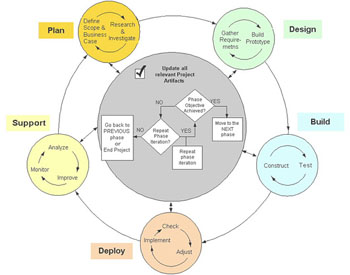 Introduction Technical projects are inherently complex and cannot succeed without careful planning. A well-planned project will be actively controlled, its progress will be visible, and its members will be given the support they need to do their work. Involving end users in the project early and continuously leads to better defined requirements and higher user satisfaction. In addition, a staged delivery approach defines the order in which the software/system will be constructed. It ensures that the solution is developed to both maximize the value to the customer at each stage and minimize the risks to the project. All of these critical elements are accounted for in the TLC methodology in order to make IS projects successful and continually increase customer satisfaction.
Mission
Why TLC?
Project's lifecycle consists of TLC 's five major phases: Plan, Design, Build, Deploy and Support. A new project would be formed in the Plan phase. If there is a sufficient business need for the project and all of the Plan phase requirements are met, the project then moves into the Design phase. During the Design Phase functional requirements are gathered in greater detail and a prototype is built if necessary. After major requirements are defined, the project moves to the Build phase in which more resources are committed to the project and the actual development begins. At the end of the Build phase, the fully functional system has passed all technical and functional testing. The project/system "goes live" in the Deploy phase. Once the project/system moves past successful implementation, it is in the Support phase. The decision making circle in the middle serves as a Checkpoint that helps the project manager determine when an iteration of a phase is complete and whether all of the relevant artifacts coming out of the respective phases are sufficient to move the project to the next phase. All artifacts are also updated at this point to reflect the current status of the project. |
|
|||||||||||||||||||||||||||||||||||
|
© 2001-2004 | DePaul University | Disclaimer | Webmaster 1 E. Jackson Chicago IL 60604 | 312-362-8000 |