















 | What We Do How We Do It How We Are Organized Our Vision, Purpose & Goals Who to Call for What |



|
|||||||||||||||||||||||||||||||||||||
 |
|||||||||||||||||||||||||||||||||||||
 |

|
||||||||||||||||||||||||||||||||||||
|
Technology Life Cycle Design Phase 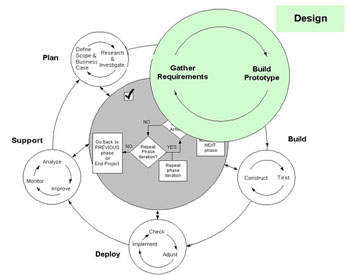 What happens during the Design Phase? The Design phase involves close collaboration with the end users to discover functional requirements in greater detail. Requirements development is the part of the project during which the needs of the customer are gathered and translated into a specification of what the system must do. The Requirements document specifies responsibilities for testing and specific requirements. The collaboration with the end users continues until a consensus is reached and the customer is ready to commit to a defined set of requirements by providing a signoff. The signoff may be sent via email or given verbally during a meeting (and documented in the minutes). As functional requirements are defined, the technical specification and testing requirements are also defined. A Test Plan is also created, based on the overall project requirements. For complex projects, multiple test plans may be developed to target specific areas. If the project involves changes that require governance board approval, the governed project design elements will be reviewed by the applicable board. At this time, projects which make changes to the portal or the data warehouse require additional approvals. If the project involves additions or changes to the data warehouse, a formal data model is required. In order to help the customer better define requirements or to test out new technology, an interactive User Interface Prototype or static project storyboards may be developed. Usability requirements will be specified and usability testing will be used for projects with a strong user experience facet.
Design Phase Artifacts/Templates How do you know when the Design phase is complete?The Design phase is complete when the requirements and test plan are complete and sufficient to realize the goals stated in the business case. While the intent is to accommodate all of the customer's requests, it is possible to get into an infinite loop of defining requirements. In order to avoid this, the Project Manager should determine how much time can be spent in this phase, based on the preliminary project deadline and the business case. Project team members should recognize that the project requirements may evolve throughout the project stages. Once the Requirements are agreed upon, any changes to the scope and/or the Requirements may result in extending the project deadline. If the deadline can not be moved or additional resources can not be assigned to the project, requested changes may have to be rejected or postponed.
|
|
|||||||||||||||||||||||||||||||||||
|
© 2001-2004 | DePaul University | Disclaimer | Webmaster 1 E. Jackson Chicago IL 60604 | 312-362-8000 |